
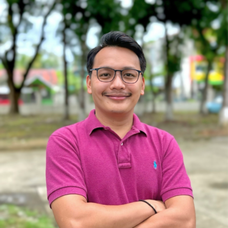
Robert Gipal
- Fulbright Scholar, Modern Languages & Literatures
I understood that being an educator goes beyond delivering content—it means meeting students where they are, adapting with empathy, and supporting their learning through uncertain times, no matter how challenging it may seem.
My experience fueled my passion for teaching and to contribute to the body of knowledge, so I wrote and published a research paper on teachers' experiences of online teaching in English as a Second Language classes during the COVID-19 pandemic. It allowed me to reflect more deeply on teachers' challenges and contribute insights that might help improve the changing educational landscapes, thinking of ways forward, without leaving anyone behind.
I am most excited to share the warmth and hospitality that define Filipino culture. I want them to experience what it truly feels like to be a Filipino and gain a good grasp of what life in the Philippines is like. Filipinos are known to be resilient, finding joy and strength even in the most challenging situations. We tend to paint a smile on our faces, even when we feel like we are being tossed in the waves.
Our identity as Filipinos is more than a matter of citizenship or ancestry; it is about a deep sense of community, often reflected in the spirit of bayanihan—the tradition of communal unity and mutual support. We are also deeply family-oriented, respectful, and generous, traits that shape how we connect with others. Through our food, traditions, stories, and my everyday interactions, I hope my students and colleagues at Gonzaga University, and in Spokane in general, will feel the sincerity, optimism, and sense of community that are central to the Filipino identity.
I also look forward to introducing students and colleagues to our rich traditions like Filipino food (such as adobo and lumpia), our popular cold dessert in the Philippines “Halo-Halo, festival like Sinulog, our values of close family ties, and unique cultural symbols like the “barong Tagalog”, as well as our custom Filipino custom of showing respect to elders “Pagmamano”
If I could design a dream classroom activity to teach Tagalog to beginners, it would be an immersive cultural simulation called “Bahay Ko, Kultura Ko” (My Home, My Culture). The classroom would be transformed into a Filipino neighborhood, with stations representing a palengke (market), jeepney ride, Filipino home, and sari-sari store. Students would take on roles as vendors, commuters, or family members and practice functional Tagalog phrases like “Magkano po ito?” (How much is this?), “Saan ang banyo?” (Where is the bathroom?), or “Tara, kain tayo!” (Let’s eat!).
The activity would offer an opportunity to subtly introduce Filipino customs, gestures, and values like pagmamano (a gesture of respect to elders) and bayanihan (community spirit). This kind of experiential learning helps students internalize language through context, culture, and connection, not just memorization.